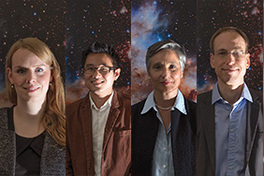
Archive | Portraits 2019

2019/11/26

© ESO/N. Bartmann

Exoplanet Research: A Rising Star of Science

The search for extraterrestrial life in the state-of-the-art space research, and its importance for life on earth: These are the main topics of this year’s Hans Sigrist Symposium due to awarding the Dutch astronomer Ignas Snellen the prestigious Hans Sigrist Prize. Kevin Heng, director of the Center for Space and Habitability (CSH) at the University of Bern, speaks in advance about the top-class conference.

2019/11/07

© CSH

Favorite drawings on the CHEOPS space telescope

The Swiss space telescope CHEOPS will soon be launched from the European spaceport in French Guiana to study exoplanets. On board the satellite are two panels with 2,748 miniaturized children's drawings. Three members of the CHEOPS team in Bern introduce themselves and their favorite drawings.

2019/10/28

© University of Bern, Image: Vera Knöpfel

"We want to renegotiate the boundaries between religion and science"

Interdisciplinarity is a top priority at the University of Bern. This is because important questions can only be answered today if the disciplines work together. In the case of the CSH Science and Religion Forum, this involves space research, theology, and philosophy. At the international conference in early November, they will jointly address the boundaries between the natural sciences, religion, and philosophy.
2019/10/14

© Alessandro Della Bella

"They both live on another planet now."

Willy Benz is particularly pleased about this year's Nobel Prize in Physics for the Swiss astronomers Michel Mayor and Didier Queloz. He was Michel Mayor's first PhD student at the University of Geneva. Today he is Professor at the University of Bern, Director of the National Centre of Competence in Research (NCCR) PlanetS and President of the Council of the European Southern Observatory ESO.

2019/08/19

© Airbus Defence and Space, Spain

CHEOPS is ready for transport to the spaceport

The launch of the Bernese space telescope CHEOPS is scheduled for the last quarter of 2019. “In July, we carried out the final tests on the instrument at Airbus in Madrid,” says project manager Christopher Broeg. CHEOPS is now ready for transport from Madrid to the Kourou spaceport in French Guiana. From there, CHEOPS will begin its journey into space.

2019/06/19

© NASA/J. Young

"We had the time of our lives"

Charles Duke was the tenth person to walk on the moon and, on April 21, 1972, he deployed a Bernese solar wind sail as part of the Apollo 16 mission. Herbert Cerutti was an assistant at the University of Bern's Physics Institute at the time and evaluated data from the solar wind sails. Now he asks Charlie Duke about his memories of this legendary time.

Audio recordings of the interview (in English) are available here: 1) Solar Wind Sail of the University of Bern, 2) Lunar Rover and "Olympic Games", and 3) Lasting Memories.

2019/06/16

© NASA

Bern in Space: From the Moon to Jupiter

At the end of June, the University of Bern will celebrate the 50th anniversary of the first moon landing with a big science festival open to the public. Since 1967, the University of Bern has been participating in missions organized by the space agencies ESA, NASA, Roscosmos, JAXA, and other international space activities. “uniaktuell” provides an insight into the fascinating space missions in which Bern is involved.

2019/06/13

© University of Bern, Image: Manu Friederich

From the University of Bern to NASA

He grew up in Heiligenschwendi and studied at the University of Bern, where he earned his doctorate in experimental astrophysics in 1996. Today, Thomas Zurbuchen is NASA's Associate Administrator for Science. He will be taking part in the celebrations “Bern in Space: Celebrating 50 Years of the Moon Landing.”

2019/06/10

© University of Bern

UniPress on the 50th Anniversary of the First Moon Landing

This issue of UniPress, the University of Bern's science magazine, was dedicated to the 50th anniversary of the moon landing. The issue features the Charlie Duke interviews, the reprint of the 1998 UniPress article on Johannes Geiss, and contains eight special pages on space research in Bern.

2019/06/06

© University of Bern

How Bern got to the Moon

When Buzz Aldrin became the second man to step out of the lunar module on July 21, 1969, the first thing he did was unfurl the University of Bern's solar wind sail and plant it in the moon's soil, even before the American flag. The current issue of “UniPress,” the University of Bern's science magazine, is dedicated to the 50th anniversary of the moon landing. This preview article tells the story of how the solar wind sail got to the moon.

2019/06/04

© University of Bern

Oral History: Prof. em. Dr. Kathrin Altwegg

"It touches your heart to see your own 'baby' fly away." Kathrin Altwegg talks about spectacular space missions, cosmic ducks, and smelly comets.

2019/06/04

© University of Bern

Oral History: Prof. em. Dr. Hans Balsiger

"We can fly to comets. For us Bernese, that was the ultimate achievement." Hans Balsiger on his career, the launch of Apollo 11, and Bern's participation in international comet missions.

2019/06/04

© University of Bern

Oral History: Prof. em. Dr. Peter Bochsler

"We rented a TV especially for the lab so we could watch the moon landing." Peter Bochsler on collaborating with Russia and the US, cosmic radiation, and solar wind measurements.

2019/06/04

© University of Bern

Oral History: Prof. em. Dr. Otto Eugster

"We had the great privilege of being able to participate in the NASA program." Otto Eugster on the Swiss cross on the moon, moon rocks in quarantine, and extraterrestrial minerals.

2019/06/04

© University of Bern

Oral History: Dr. Jürg Meister

"Unfortunately, there are no clotheslines on the moon!" Dr. Jürg Meister explains what selfie sticks and roller blind have to do with the development of the Bernese sun sail.

2019/06/04

© University of Bern

Oral History: Prof. em. Dr. Ernest Kopp

"In Bern, we were able to produce all the technology in-house." Ernest Kopp on forgotten "Öl-Pintli" in Sardinia, rapid rocket launches, and the secret to the success of Bernese space researchers.

2019/06/04

© University of Bern

Oral History: Prof. Dr. Claude Nicollier

"The people of Bern are passionate, talented and have first-class instruments." Switzerland's only astronaut, Claude Nicollier, talks about his unusual career, his favorite flights, and the role of Bernese astrophysics.

2019/06/04

© University of Bern

Oral History: Urs Schwab

"I was a physics lab assistant in my second year of training and was involved from the very beginning." Urs Schwab on the development of the "holy foil" and dangerous experiments.

2019/01/29

© University of Bern, Image: Vera Knöpfel

China looks to Bernese space expertise

A delegation of Chinese space researchers tested and calibrated an instrument for China's 2020 mission to Mars at the University of Bern. Even the "Tagesschau" was interested. The inside story.