Portraits and Interviews

Learn more about our researchers through CSH and UniAktuell portraits and interviews.

2025/05/07

Making science tangible with art

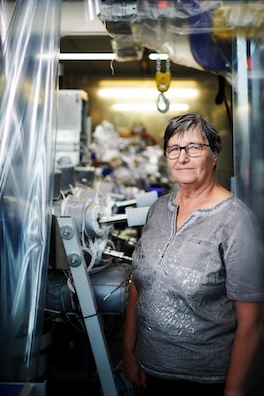
How do you make the tectonic development of the planet Mercury tangible with a piece of paper? For planetary scientist Liliane Burkhard, the answer is clear: with the means of art. While she works at the Institute of Physics in the Space Research and Planetary Sciences Divison, she thinks not only in terms of science, but also in terms of artistic forms and structures.

2025/04/03

Congratulations to Christopher Broeg, new PI of CHEOPS

For more than five years, the Bern-based CHEOPS telescope has been providing highly precise data from space. At the beginning of 2025, Christopher Broeg took over the leadership of the mission from Willy Benz. Now the two have met for a conversation for uniAKTUELL.

2025/03/14

© University of Bern/UniAKTUELL

"As a woman, you're often alone but also highly visible"

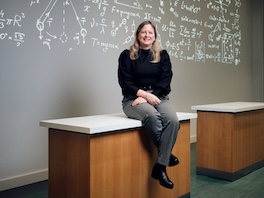
Audrey Vorburger is a planetary scientist and a mother of three children. In the video, she talks about the search for life beyond Earth and her experiences in a male-dominated professional field.
2024/08/28

© University of Bern/UniAKTUELL

Uni Bern Searching for Life in Space

The ESA mission Juice launched in April 2023 to Jupiter to search for signs of life on three icy moons. Astrophysicist Audrey Vorburger talks about the University of Bern's involvement in this space adventure.

2024/07/12

New partnership with NASA

A new network of Swiss research institutions teams up with NASA to accelerate the exploration of the Moon, Mars, and beyond. Valentin Bickel, planetary scientist at the Center for Space and Habitability (CSH), is the principal investigator of the Swiss research network CHEESE.

2024/06/03

© iStock

Will there soon be solar power plants in space?

A question for Christoph Mordasini: Solar power plants in space will one day collect solar energy and send it back to Earth. But can that really work?

2024/05/29

© University of Bern/UniAKTUELL

Comet research with Bernese instruments

The University of Bern is contributing two instruments to the European Space Agency's (ESA) Comet Interceptor Mission, which is due to set off for a comet in 2029. Martin Rubin explains the importance of this mission for understanding our origins.

Archive - Portraits

2023/12/22

© University of Bern/UniAKTUELL

The sun in view

Lucia Kleint researches powerful solar storms that can cause major problems on Earth. In a video interview, the active researcher explains why the University of Bern is the perfect place for her research.

2023/12/13

© University of Bern, Image: Ramon Lehmann

Space Telescope Made in Bern

For four years now, the CHEOPS space telescope has been astonishing us with its discoveries. Willy Benz, head of the CHEOPS consortium, talks about the fascination of space and the challenges involved in building a space instrument in Bern.

2023/11/30

© University of Bern/UniAKTUELL

Visitor from outer space

'Oumuamua is the first interstellar object ever observed in our solar system. In a video interview, Niels Ligterink from the University of Bern presents new research findings on why 'Oumuamua accelerated as it passed by the sun.

2023/06/02

© Global Science Film Festival

She turned the space explorer into a detective

Tatiana Keller (Drozhzhova) is a particle physicist with a PhD and a filmmaker. As a member of astrophysicist Nicolas Thomas’ research group at the University of Bern, she came up with the idea of making a short film series about CaSSIS, the Mars camera developed in Bern, and the mysteries of the red planet.

2023/03/27

© University of Bern/Ramon Lehmann/Axel Murk

Challenges on the way to Jupiter

Peter Wurz, Nicolas Thomas and Axel Murk have all been involved in the ESA mission Juice from the very beginning. For uniAKTUELL, they look back and talk about the challenges they have already encountered on the way to the largest planet in the solar system and those that still await them.

2023/03/15

© University of Bern, Image: Thierry de Roche

How to build a space probe

Administration, design, mechanics, electronics, software development, science and project management: for the construction of space instruments, as with complex puzzles, a wide variety of components must be compiled into a whole. How does this work?

2023/03/08

© University of Bern, Image: Vera Knöpfel

Bern's Interstellar Head Chef

Maria Drozdovskaya searches for recipes every day. But not for balanced main courses or fine desserts, but for comets, stars, and planets. In her research, she investigates how astrochemical processes form celestial bodies from dust grains, gases, and ices – and perhaps also life.

2023/03/06

© University of Bern/UniAKTUELL

From vision to mission

The European Space Agency’s Juice space mission is scheduled to start its journey to Jupiter on April 13, 2023, where it will, among other things, search for traces of life on three of Jupiter’s icy moons. The University of Bern is strongly involved in this project. uniAKTUELL introduces local researchers Yann Alibert, Audrey Vorburger, André Galli and Andreas Riedo, who are working hard on accomplishing the Juice mission.

2022/11/11

© Adrian Jäggi

Bernese Astronomy celebrates double anniversary

The Astronomical Institute of the University of Bern (AIUB) is celebrating a double anniversary on November 25 and 26: 200 years of the "Old Observatory Bern" (Uraniae) and 100 years of the AIUB. In an interview, Director Adrian Jäggi explains how and in which areas the AIUB became a global leader.

2022/10/28

© University of Bern, Photo: Dres Hubacher

His son's smile and the call from NASA

Space scientist Andreas Riedo wants to find signs of life on Saturn’s icy moons. It is entirely probably that he won’t be able to achieve this ambitious goal himself within his professional career. And that’s why his research work always includes the promotion of early career researchers.

2022/06/09

© Alessandro della Bella

The advocate for puzzling astronomical objects

Brown dwarfs are puzzling astronomical objects that are heavier and hotter than planets, but lighter and colder than stars. A research team led by Clémence Fontanive from the University of Bern has recently directly imaged four new of these mysterious celestial bodies. In this interview, the astrophysicist explains why brown dwarfs are important to our understanding of stars and planets.

2022/06/01

© Alessandro della Bella

What do we know about ignorance?

Knowledge is commonly taken to be one of the most important values. But how is it related to its counterpart ignorance? This is the topic of the 2nd edition of the interdisciplinary "CSH Science, Philosophy and Religion Forum" which will take place from June 7 to June 9. Vera Matarese, co-organizer of the event, explains what visitors can expect and what fascinates her about the topic.

2022/05/03

© University of Bern

The man with the instruments in space

Nicolas Thomas wants to understand Mars, comets, and Jupiter's icy moons. To do this, he builds instruments that fly through space aboard space probes.

2022/03/16

© Audrey Vorburger

Bernese Astrophysicist Flying High

A major success for Audrey Vorburger: she has been elected to a specialist committee of the European Space Agency (ESA) that will define the scientific objectives of the ESA's next major space mission. In this interview, the astrophysicist explains how this came about and why Uranus is her favorite planet.

2018/08/27

CHEOPS Swiss event
Photo: © University of Bern / Adrian Moser

Bern's CHEOPS is flying into space soon

Professor Willy Benz explains details of the satellite to the guests in the clean room at RUAG.