Life Beyond Earth

© ESO/L. Calçada/N. Risinger

How do we confidently detect life beyond Earth?

What tools are at our disposal to find life in the universe? How can spectropolarimetry be used to detect life? What biosignatures exist on Earth and beyond? How does the study of life on Earth help us detect living organisms on other planetary bodies? What technology is needed to detect life?


This page is currently under construction. More information will be available soon.

B-O. Demory, A. Vorburger, A. Riedo, T. Frölicher

© NCCR Genesis

Genesis: Exploring the Emergence of Life in the Universe

NCCR Genesis offers a transformative interdisciplinary approach that brings together physics, chemistry, biology, and Earth sciences to investigate the conditions and mechanisms that enable life to arise, evolve, and persist. A central objective will be the development of robust biosignatures and innovative methods to detect them, whether through remote observations of distant worlds or direct in situ measurements. The University of Bern leads four of the 20 projects making up the research of the NCCR's Phase I.

B-O. Demory, M. Fatton, L. Patty, J. Grone, L. Brandenburg, G. Nivlet, U. Schroffenegger
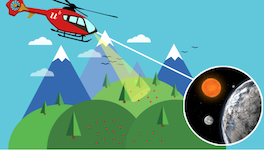
SenseLife: The Search for Life Beyond Earth

One of the most intriguing questions is whether life exists beyond Earth. To date, no direct evidence has been found, yet habitable conditions exist elsewhere in the Universe. SenseLife develops an advanced optical instrument, a full-Stokes spectropolarimeter called FlyPol. FlyPol analyzes the polarization state of light and searches for distinct polarization features produced by biological matter. In an interdisciplinary effort, we combine microbiology, optics, and engineering to search for microscopic life on planetary bodies within our Solar System.

Marrick Braam

© Marrick Braam

Prebiotic Chemistry in Exoplanet Environments

The diversity of temperate rocky exoplanets provides opportunities to study environments where life might arise. In an interdisciplinary effort combining exoplanetary science, climate modelling, and prebiotic chemistry, we aim to understand the environmental conditions on these worlds, assess whether they can support prebiotic chemistry, and explore how their atmospheres may be characterised by future space-based observatories.